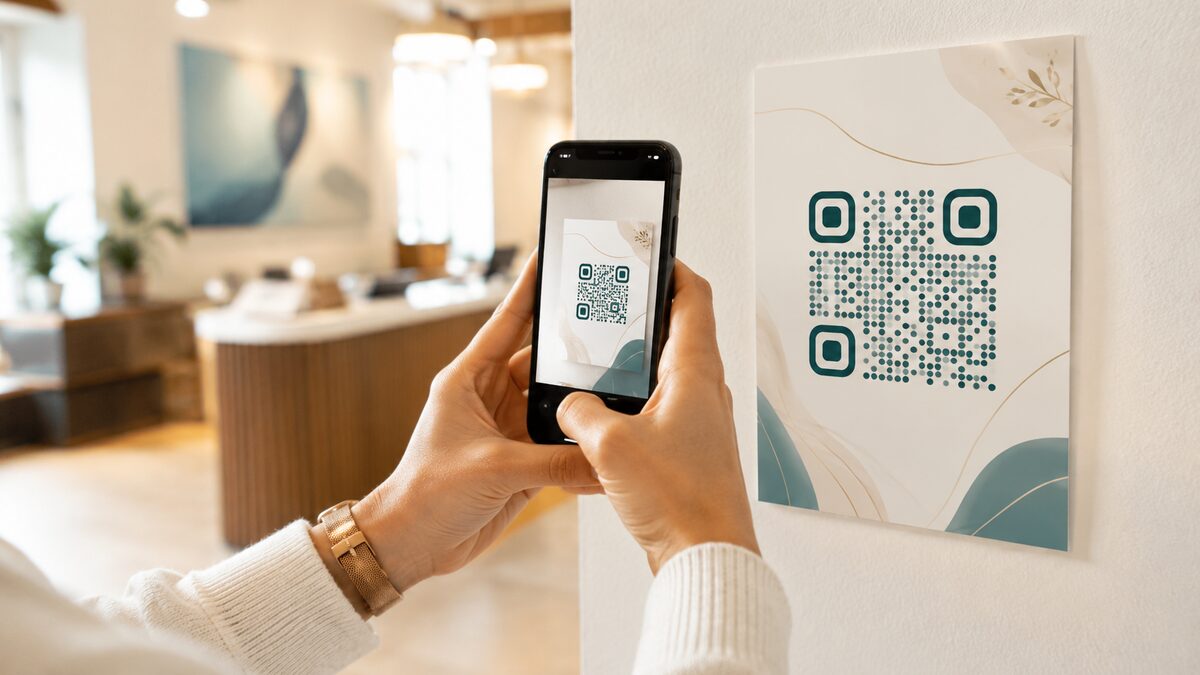
QR codes feel a little like magic — you point your camera at a pattern of squares and a website opens. But there's a beautiful, simple idea behind the most useful kind of QR code: the dynamic code. Once you understand how it works, you'll see why it changes everything about printing anything.
First, what a QR code actually is
A QR code is just a way of writing information as a pattern a camera can read — the same way a barcode writes a number as stripes. Most often, what's written inside is a web link. Your phone reads the pattern, finds the link, and opens it.
The big question is: what link is written inside? That single choice splits QR codes into two very different kinds.
Static codes: the link is baked in
In a static QR code, your final web address is written directly into the pattern. Scan it, and the phone reads your link and goes straight there. Nothing sits in between.
That has a beautiful side and a limiting side:
- Beautiful: it's permanent. Nothing can switch it off. A static code works forever, even if the company that made it disappears.
- Limiting: you can never change it, and you can never know how many people scanned it — because the scan never passes through anything that could count it.
Static codes are perfect for things set in stone: a Wi-Fi password, a fixed link, a one-time use.
Dynamic codes: the link points to a doorway
A dynamic QR code does something clever. Instead of writing your final address into the pattern, it writes a short redirect link — a little doorway you control. Your real destination lives behind that doorway, where you can change it anytime.
Here's the journey of a single scan, step by step:
- Someone points their camera at your code.
- The phone reads the short link (something like
qr.qryzen.com/abc123). - The phone visits that short link, which lands on a tiny, fast service called a redirect engine.
- The engine looks up where you've currently pointed this code and replies, in milliseconds, "go here instead."
- The phone follows that instruction and opens your real destination.
To the person scanning, it's instant and invisible — they just see your page open. But that extra half-step is where all the power lives.
Think of a static code as an address carved in stone, and a dynamic code as a signpost you can repaint. The signpost stays planted in the same spot forever; you just change where it points.
Why that doorway is so powerful
Because your real destination lives behind a link you control, two superpowers appear:
1. You can edit it anytime — even after printing. Printed 500 menus and your prices changed? Update the destination from your dashboard, and every one of those printed codes now opens the new menu. The ink never changes; the destination does. No reprinting, ever.
2. You can track every scan. Since every scan passes through the redirect engine on its way through, that's the moment it can be counted. You learn how many people scanned, when, roughly where (city and country, from the network), and on what kind of device — all without collecting anything personal.
What you can do with that
- A restaurant menu you change from your phone as dishes sell out.
- A product label whose story, video or offer you update long after the box is printed.
- A digital business card that always shows your current number and title.
- A campaign flyer you can finally measure — did anyone actually scan it?
- A review code that quietly sends happy customers to your Google listing.
One printed code, a destination that grows and changes with you.
The honest catch (and how to avoid it)
A dynamic code depends on that redirect doorway staying open. That's why who you make your code with matters. Some "free" tools quietly switch off dynamic codes when a trial ends — and your printed code dies.
A trustworthy platform does two things: keeps static codes free forever (so a permanent code is always an option), and makes sure a dynamic code, if a plan ever lapses, shows a polite branded page rather than a dead link — and springs back the moment you renew. The promise should be simple: never break a printed code.
So, which should you use?
- The link will never change and you don't need numbers → a static code (free and permanent).
- You'll want to edit it later, or you want to measure it → a dynamic code.
For most businesses, that means dynamic — because the printed thing always outlives the content behind it, and knowing what's working is worth a lot.
Try it in a minute
The best way to understand a dynamic QR code is to make one, scan it, then change where it points and watch the same code open somewhere new. You can do exactly that, free, at QRYZEN — and watch the scans roll in on your dashboard.